
Brass Panchmukhi Hanuman: History and Popularity
Walk into enough Indian homes, shops, or even taxis, and sooner or later you’ll spot him: a brass Hanuman idol with five faces, each staring off in a different direction, usually placed somewhere prominent — above a doorway, on a puja shelf, or wedged onto a car dashboard next to the rearview mirror. If you’ve ever wondered why this particular form of Hanuman shows up so often, or whether it’s even “allowed” to keep one at home, you’re asking one of the most commonly searched questions about Indian devotional decor.
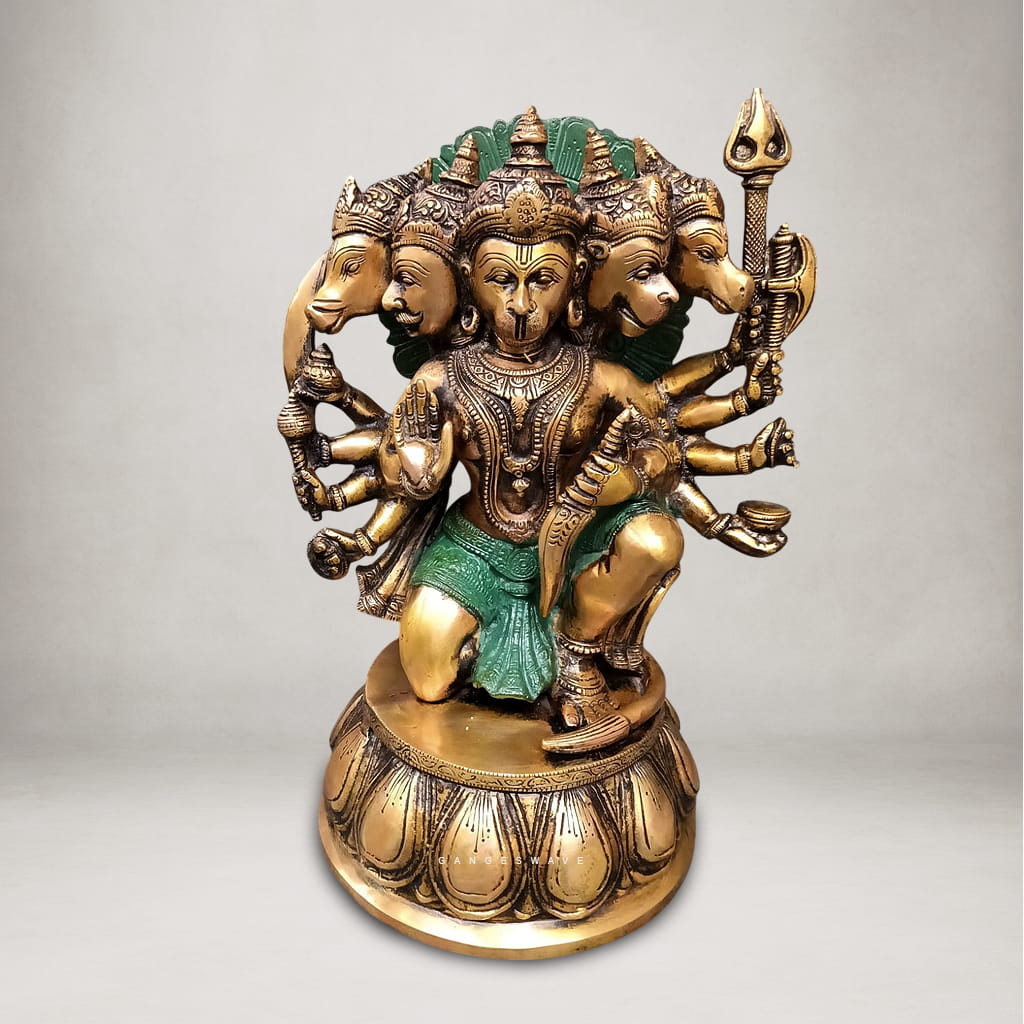
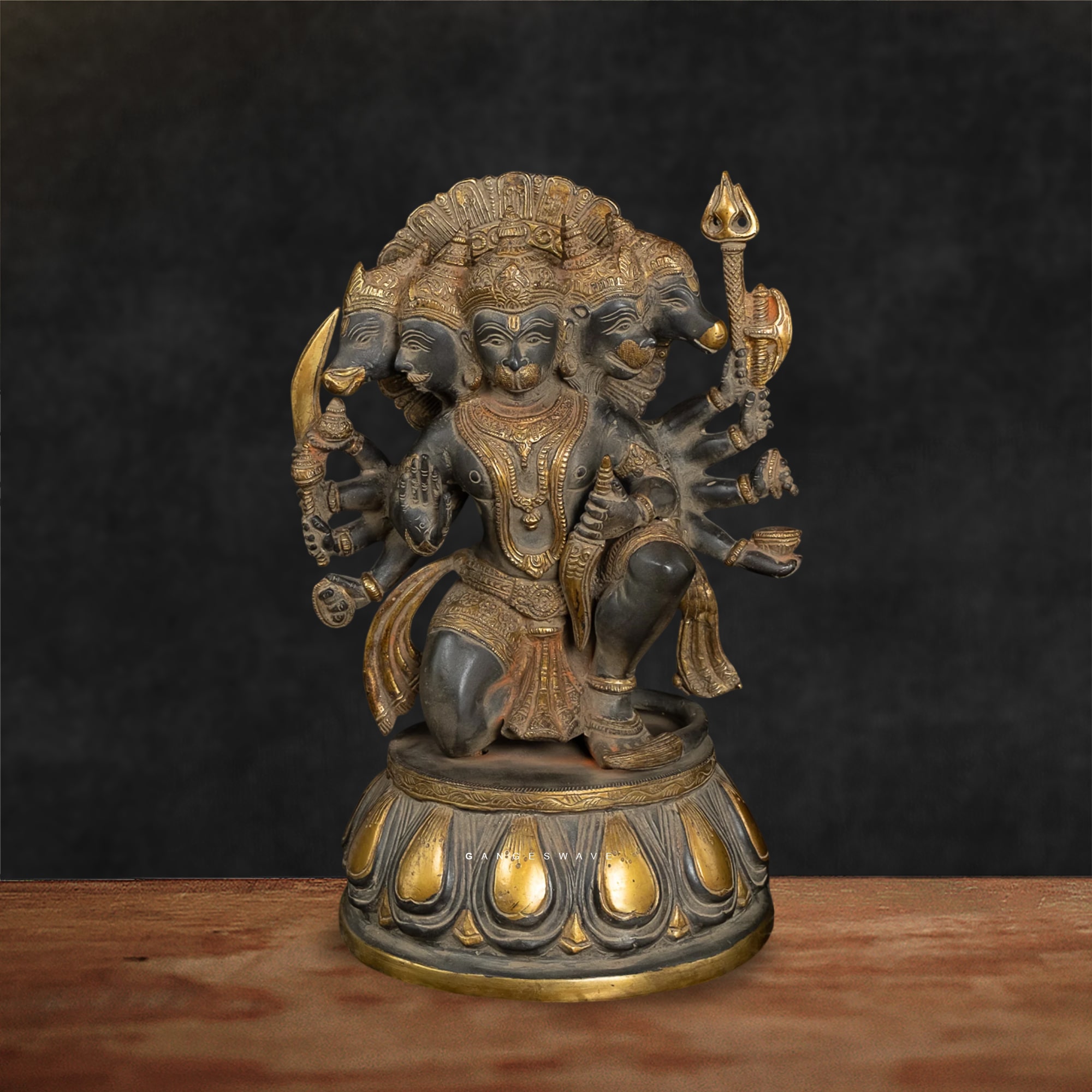
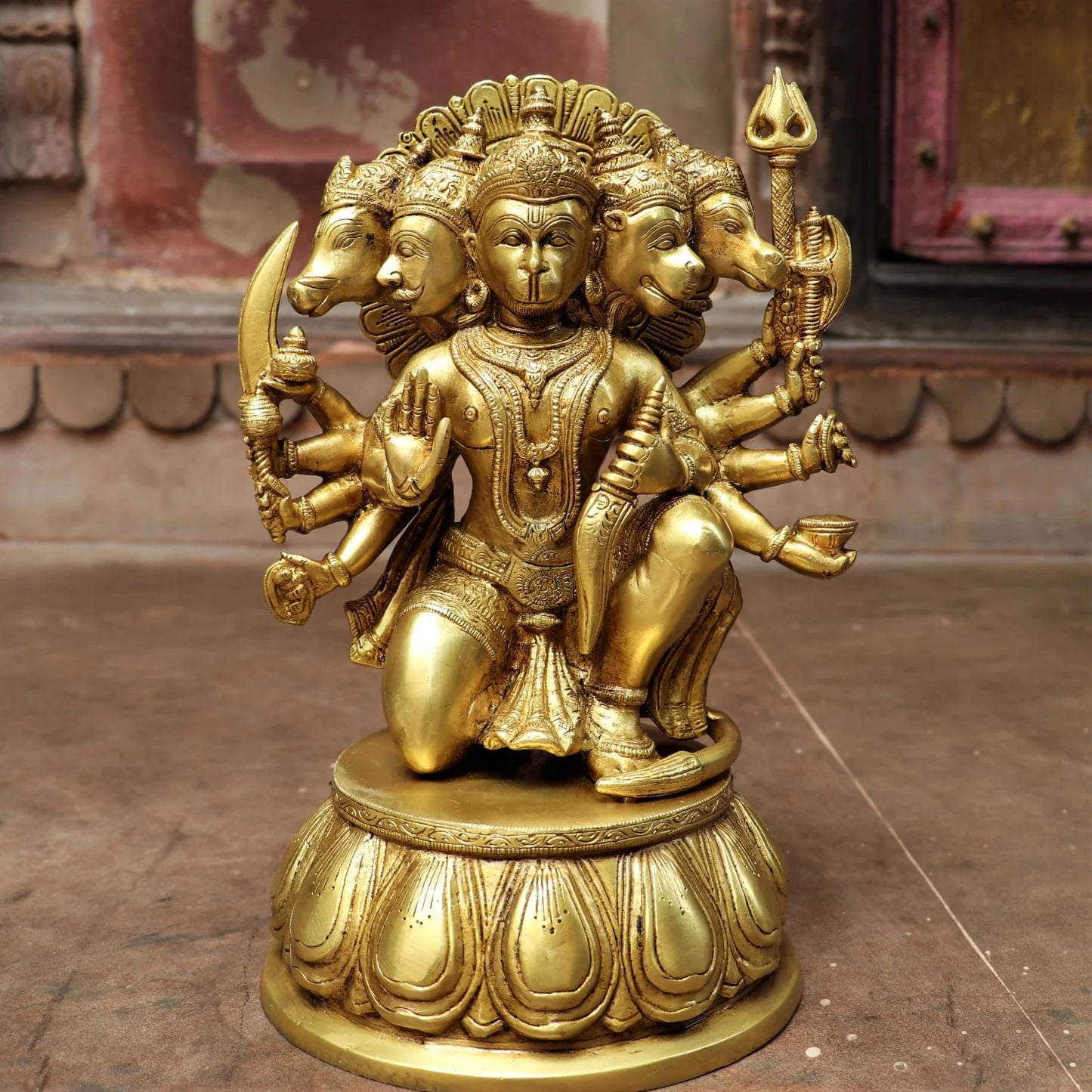
Panchmukhi Hanuman is the five-faced form of Lord Hanuman — his own face joined by Narasimha, Garuda, Varaha, and Hayagriva, each facing a different direction. According to the Krittivasi Ramayana and later devotional traditions, Hanuman took this form to defeat the sorcerer-king Ahiravana (also called Mahiravana) and rescue Rama and Lakshmana from the underworld. Today it’s one of the most widely kept protective idols in Hindu homes, cars, and shops, chosen specifically for the belief that it guards against danger from every direction at once.
Note: The Ahiravana story comes from the Krittivasi Ramayana (Bengali) and Kamba Ramayana (Tamil) traditions rather than the original Valmiki Ramayana, and even devotees disagree on some of the placement rules below. This post is upfront about where opinions differ, rather than presenting one version as the only correct one.
Hanuman statue in your home is a great idea:
- Protection: Panchmukhi Hanuman is known for his ability to protect his devotees from negative energy, evil spirits, accidents, and illnesses. By keeping a Panchmukhi Hanuman statue in your home, you can create a protective shield around your loved ones and yourself.
- Peace and harmony: Each of the five faces of Panchmukhi Hanuman represents a different aspect of his peaceful nature. By keeping a Panchmukhi Hanuman statue in your home, you can promote a peaceful and harmonious environment that fosters positivity and wellbeing.
- Strength and courage: Panchmukhi Hanuman represents different aspects of strength and power, including physical, mental, and spiritual strength. By keeping a Panchmukhi Hanuman statue in your home, you can draw on his strength and courage to face challenges and overcome obstacles in your life.
- Success and prosperity: Hanuman is known for his ability to help his devotees achieve their goals and overcome obstacles. By keeping a Panchmukhi Hanuman statue in your home, you can tap into his energy to help you achieve success in all areas of your life.
Is Panchmukhi Hanuman Different From a Regular Hanuman Idol?
Yes — and this is usually the first thing people want to know before anything else. A “regular” Hanuman idol shows a single face, almost always in a posture of devotion or service to Rama — kneeling, hands folded, or carrying the Sanjeevani mountain. Panchmukhi Hanuman is a different kind of representation altogether: a virata (colossal, cosmic) form with five heads, each looking in a different direction, combining Hanuman’s own face with four other divine faces.
Think of it this way: a single-faced Hanuman is Hanuman in his role as devotee. Panchmukhi Hanuman is Hanuman in his role as protector — deployed, according to the story, at the one moment he needed more than one face to get the job done.
The Story Behind the Five Faces
Here’s the part almost nobody tells you when they explain the five faces — it wasn’t a stylistic choice. It was a very specific problem that could only be solved one way.
During the war in Lanka, with Ravana’s army thinning out, he called in Ahiravana (also spelled Mahiravana) — a sorcerer-king ruling Patala Lok, the underworld, and a devotee of the goddess Chandi. While Rama and Lakshmana’s camp slept, Ahiravana slipped past the guards and carried the two brothers down to Patala, planning to sacrifice them at dawn.
Hanuman went after them. He found Ahiravana, fought him, and lost — not from lack of strength, but because he didn’t yet understand the trick keeping the sorcerer alive. Ahiravana’s life force was tied to five lamps, burning simultaneously in five separate directions of the chamber. Put out four, and the fifth would bring him straight back. The only way to kill him was to extinguish all five at the exact same instant — something no single face, looking in only one direction, could ever manage.
So Hanuman didn’t just get stronger. He changed the shape of the problem. He took on five faces at once — one for each direction — and snuffed out all five lamps in a single breath, killing Ahiravana and freeing Rama and Lakshmana on the spot.
It’s this detail — that the five faces were a solution to an impossible problem, not decoration — that explains why the form has stuck around for centuries as a symbol of protection specifically. It isn’t just “Hanuman, but more powerful.” It’s Hanuman doing the one thing that shouldn’t have been possible.
| Face | Direction | What It’s Believed to Guard Against / Grant |
|---|---|---|
| Hanuman (Anjaneya) | East | His own face — devotion, humility, service to Rama |
| Narasimha | South | Fear, enemies, and hostile intentions (Vishnu’s fierce lion-man form) |
| Garuda | West | Poison, negative planetary influence; grants swiftness |
| Varaha | North | Instability and financial setbacks; associated with strength and prosperity |
| Hayagriva | Upward (zenith) | Confusion and ignorance; grants knowledge and clarity |
One detail worth knowing if you ever get asked about it: four of the five faces — Narasimha, Garuda, Varaha, and Hayagriva — are themselves forms or companions of Vishnu. Since Rama is considered an avatar of Vishnu, the choice of faces isn’t random. It’s Hanuman, Rama’s most devoted servant, calling on the full weight of Vishnu’s own power to protect his master. The five-face form is as much a statement about total devotion as it is about strength.
Why So Many People Keep One at Home
This is where the story stops being ancient history and starts being genuinely relevant to why people are searching for this today. Hanuman is one of the most actively worshipped deities in contemporary Hinduism precisely because he’s seen as accessible and responsive — the deity people turn to specifically during hard times, uncertainty, or when something in life feels like it’s coming at them from too many directions at once (a job loss, a health scare, a difficult move, a run of bad luck).
Panchmukhi Hanuman, specifically, tends to get chosen over a single-faced idol when the intent is protection rather than quiet daily devotion. That’s why you’ll see it disproportionately in three specific spots:
- Above or near the main door — the idea being that a form facing multiple directions at once is better suited to guarding an entrance than a form facing only one way.
- On car dashboards — an extremely common, low-key form of daily devotion; many drivers keep a small Panchmukhi idol or sticker on the dash and recite even a short prayer before a long drive.
- In home puja rooms during a difficult period — people often bring one into the house specifically after a string of setbacks, rather than as a first idol for a new home shrine.
None of this is exclusive to Panchmukhi Hanuman, but it’s worshipped for this particular reason more consistently than most other Hanuman forms.
Can You Keep Panchmukhi Hanuman at Home, or Is It Only for Temples?
This is a genuinely debated question, and it’s worth being honest about that instead of picking a side and stating it as settled fact.
One school of thought — drawing on the Rudrayamala Tantra, a Tantric text — holds that a Panchmukhi Hanuman idol is more appropriate placed outside a home (at the entrance, gate, or compound wall) rather than inside living spaces, and that keeping more than one multi-faced idol indoors can create restless rather than calm energy.
In practice, though, millions of households across India keep Panchmukhi Hanuman inside the home without issue — in the puja room, on an entrance-facing wall, or even on a shelf in the living room — and this is entirely standard, widely accepted devotional practice in most communities. The stricter “outside only” view tends to come up more in Tantric and Vastu-focused circles than in everyday household practice.
If you’re unsure, the most common approach that satisfies both views is simple: place it at or near the entrance, facing outward, rather than deep inside a bedroom or private space. That keeps its protective symbolism intact either way. Beyond that, following your own family’s tradition or checking with a priest you trust is more reliable than any single blog post’s rule.

Why Is It Almost Always Made of Brass?
A few reasons brass has stuck as the default material, beyond just tradition:
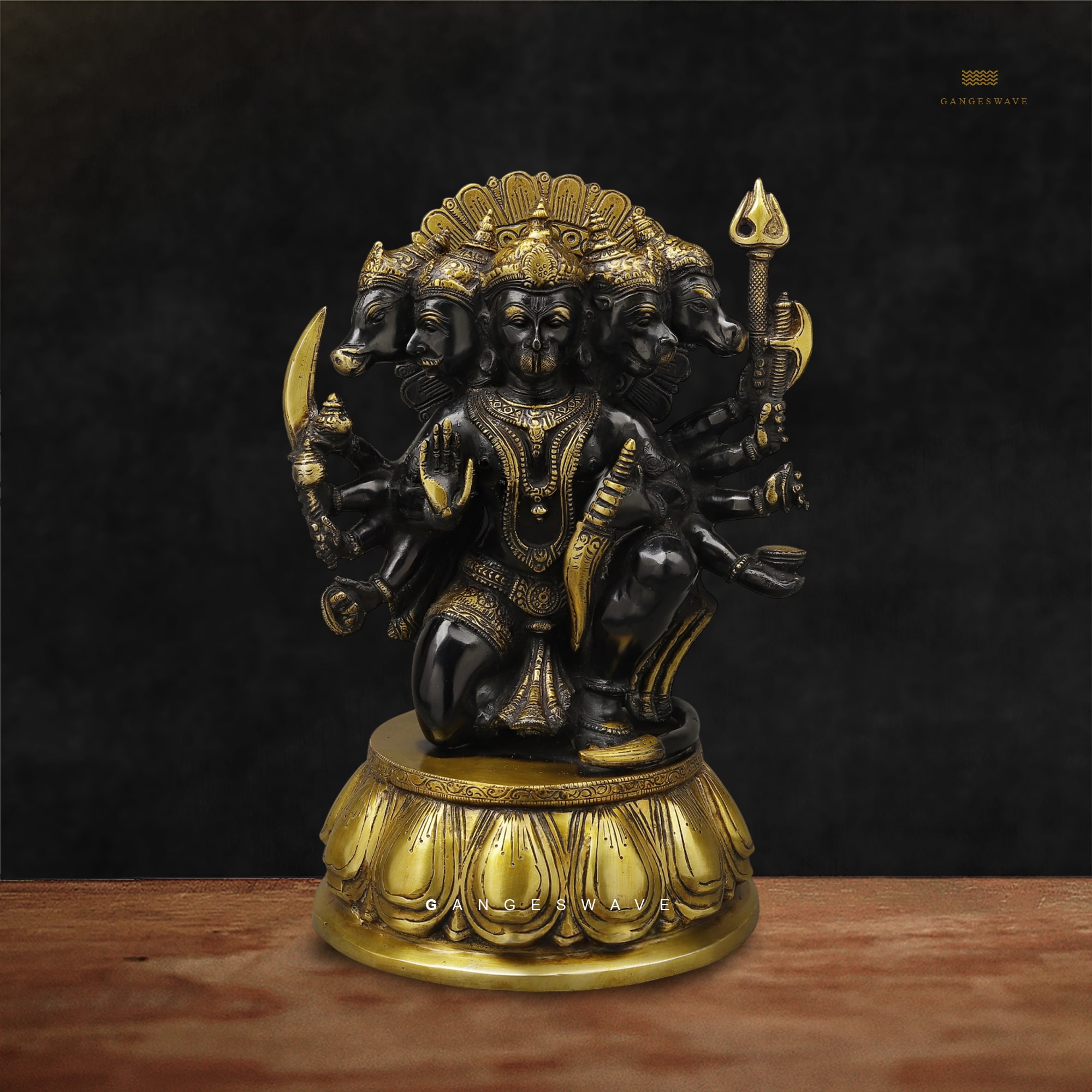
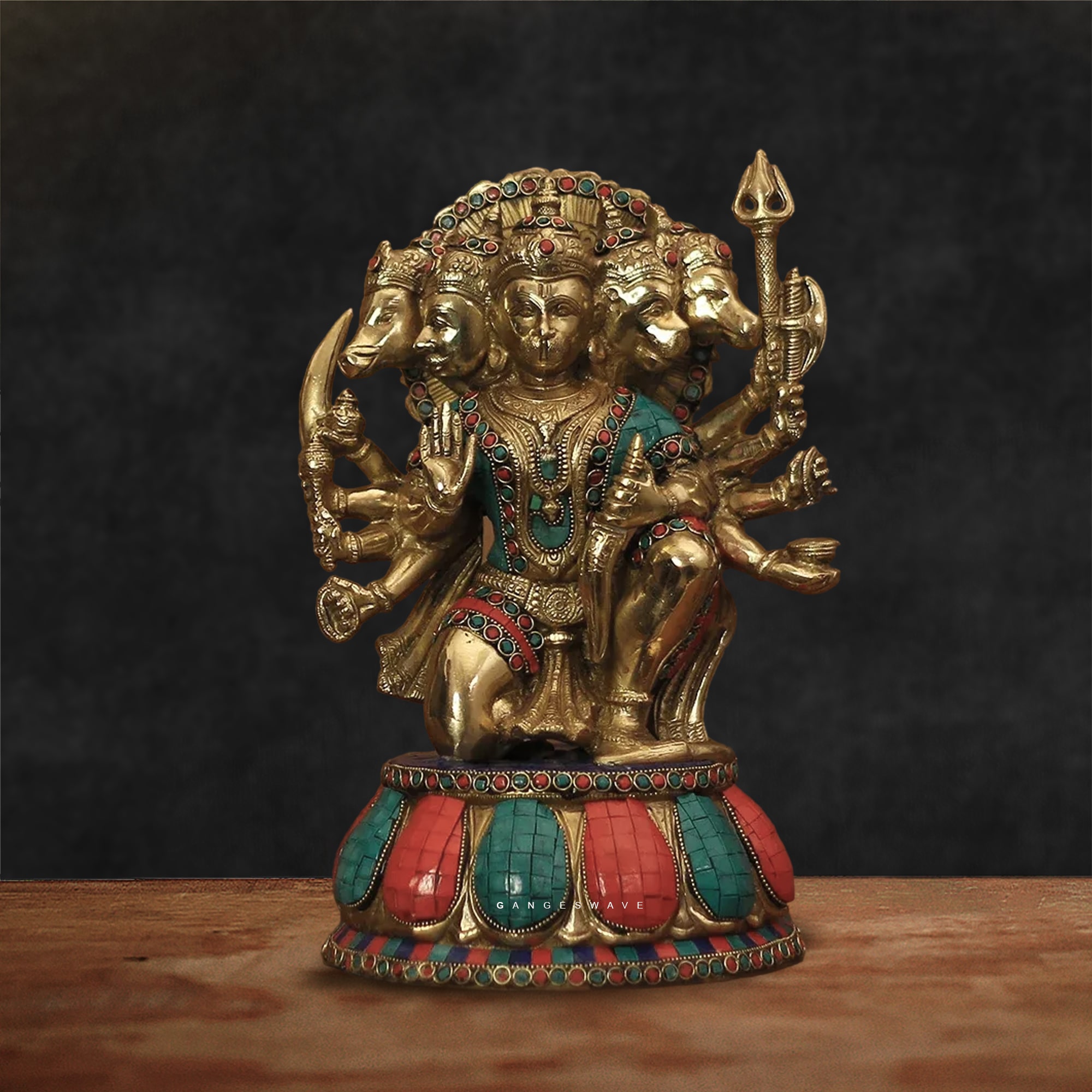
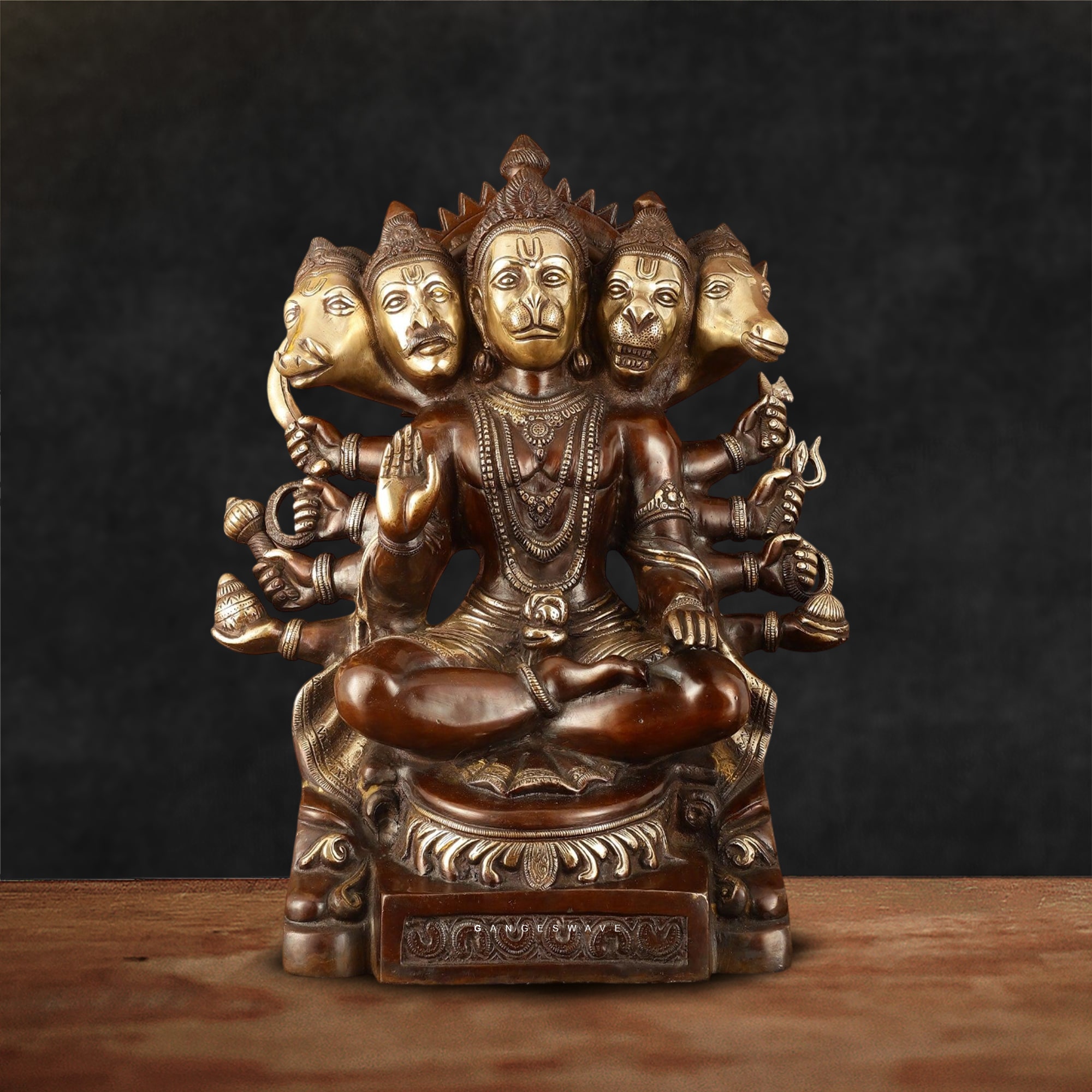
- The detail actually needs to hold up. Five faces — a lion’s mane, an eagle’s beak, a boar’s snout, a horse-like face, and Hanuman’s own features — all have to read clearly, often at a fairly small scale. Brass casting keeps that detail sharp in a way softer metals struggle with.
- It’s placed somewhere that gets touched a lot. An idol kept at an entrance or handled daily for a quick prayer before leaving the house needs to hold up to that — brass wears well under frequent contact.
- The patina is considered a feature, not a flaw. A brass Panchmukhi Hanuman that’s been worshipped daily for years develops a deeper, richer finish over time — many households see that as a sign of an idol that’s actually been lived with and prayed to, not one sitting untouched on a shelf.
Famous Temples Where People Go to See Him
If you want to see the form at scale rather than in idol size, a couple of temples are specifically known for it:
- Mahavir Mandir, Patna — one of the most visited Hanuman temples in India, drawing enormous crowds year-round.
- Panchmukhi Hanuman Temple, Rameswaram — a temple specifically dedicated to this five-faced form, part of the wider Rameswaram pilgrimage circuit.
Beyond these two, smaller Panchmukhi Hanuman shrines are common across South Indian temple complexes, usually installed alongside a main deity specifically as a dedicated protective figure.
Which Way Should It Face? (And Why Nobody Fully Agrees)
If you search this question, you’ll get genuinely conflicting answers within the first page of results — and it’s worth knowing why, rather than just picking whichever one you saw first.
The most commonly cited reasoning is tied directly to the mythology: since the south-facing Narasimha face is believed to guard against the heavier energies traditionally associated with the south direction, many people place the idol so it faces south specifically for that protective reason. Others apply the more general Vastu convention used for most deities — northeast or east placement, with the worshipper facing east while praying.
A few things most sources do agree on, regardless of which direction camp they’re in:
- Keep it elevated — never directly on the floor.
- Keep it away from bedrooms and anywhere near a bathroom.
- Keep the space around it clean and uncluttered.
- A lit diya nearby is considered an important, active part of its presence — not optional decoration.
If the specific direction really matters to you, it’s worth asking a priest who knows your home’s layout rather than relying on any single source online — this is one of the few areas where regional and family tradition genuinely varies more than most articles admit.
The Panchmukhi Hanuman Mantra
People often ask not just “what’s the mantra” but “how many times am I actually supposed to say it.” The commonly used Gayatri mantra for this form is:
Om Anjaneyaya Vidmahe Panchavaktraya Dheemahi Tanno Hanumath Prachodayat
It’s traditionally chanted in rounds of 108 (a full mala), though many people simply chant it as many times as feels right for their own practice — there’s no strict rule that invalidates a shorter or longer count. Tuesdays and Saturdays are considered the most auspicious days specifically for Hanuman worship, so that’s when you’ll often see people chanting it more deliberately, even if they don’t manage a daily practice the rest of the week.
Choosing One: Home Shelf, Entrance, or Car Dashboard
Where you’re planning to put it should genuinely drive what you buy, more than most people initially realize:
- For a puja shelf — a seated Panchmukhi Hanuman generally reads as calmer and more devotional, which tends to suit daily worship better than a battle-ready standing pose.
- For an entrance or main door — a standing or more dynamic posture, often holding a mace (gada), leans into the protective symbolism more directly.
- For a car dashboard — look specifically for pieces made or sized for that purpose; a small, stable-based idol (rather than a tall, top-heavy one) holds up much better to the vibration and movement of daily driving.
- Whatever the setting, make sure all five faces are actually distinguishable from each other — a well-made idol lets you tell Narasimha’s mane from Garuda’s beak at a glance. If all five faces look nearly identical, that’s usually a sign of lower-quality casting.
Keeping It Looking (and Feeling) Right
- Dust each face individually with a soft brush — five faces means five sets of crevices where dust builds up faster than on a single-face idol.
- Skip the harsh chemical polish — it can flatten the fine detail that distinguishes one face from another.
- Dry it thoroughly after any ritual bathing (abhishekam), especially around the base and facial detail.
- Once you’ve placed it, try not to move it around too much — frequent repositioning is one of the more common ways the finer facial detailing gets chipped over time.
Frequently Asked Questions
Is Panchmukhi Hanuman different from a normal Hanuman idol?
Yes. A regular Hanuman idol shows a single face, usually in a devotional pose toward Rama, while Panchmukhi Hanuman has five faces — his own plus Narasimha, Garuda, Varaha, and Hayagriva — representing a protective, cosmic form rather than a purely devotional one.
Can I keep Panchmukhi Hanuman at home, or is it only for temples?
This is genuinely debated. One Tantric tradition (the Rudrayamala Tantra) suggests keeping it outside the home, at the entrance, while millions of households worship it inside the home without issue as part of standard devotional practice. A common middle ground is placing it near the entrance, facing outward.
Can I keep a Panchmukhi Hanuman idol in my car?
Yes, this is a widely followed and common practice. Many drivers keep a small idol on the dashboard and offer a brief prayer or recite the Hanuman Chalisa before a journey, treating it as a form of daily, on-the-go devotion.
What is the Panchmukhi Hanuman mantra, and how many times should I chant it?
A commonly used mantra is "Om Anjaneyaya Vidmahe Panchavaktraya Dheemahi Tanno Hanumath Prachodayat," traditionally chanted in rounds of 108, though many people chant it as many times as suits their own practice.
Should Panchmukhi Hanuman be placed above the main door?
This is a common practice, based on the idea that a form facing multiple directions at once is well suited to guarding an entrance. It's widely followed but not universal — some households instead keep it inside the puja room.
Which direction should a Panchmukhi Hanuman idol face at home?
Opinions genuinely differ. Some recommend south, based on the protective Narasimha face guarding that direction; others follow the general Vastu convention of northeast or east. Regional and family tradition varies, so it's worth checking with a priest familiar with your home.
Why did Hanuman take five faces instead of just fighting harder?
According to the Krittivasi Ramayana tradition, the demon Ahiravana's life was tied to five lamps burning in five directions that had to be extinguished at the exact same instant — something impossible with a single face. Taking on five faces was the specific solution to that specific problem, not simply a show of extra strength.
Why is brass the preferred material for Panchmukhi Hanuman idols?
Type yWhy is brass the preferred material for Panchmukhi Hanuman idols?
Looking for a brass Panchmukhi Hanuman with all five faces clearly, properly detailed — for your entrance, puja shelf, or car? Explore GangesWave’s handcrafted collection, made by traditional Indian artisans, at GangesWave.