
Selecting Brass Navagraha Idols for Astrological Balance
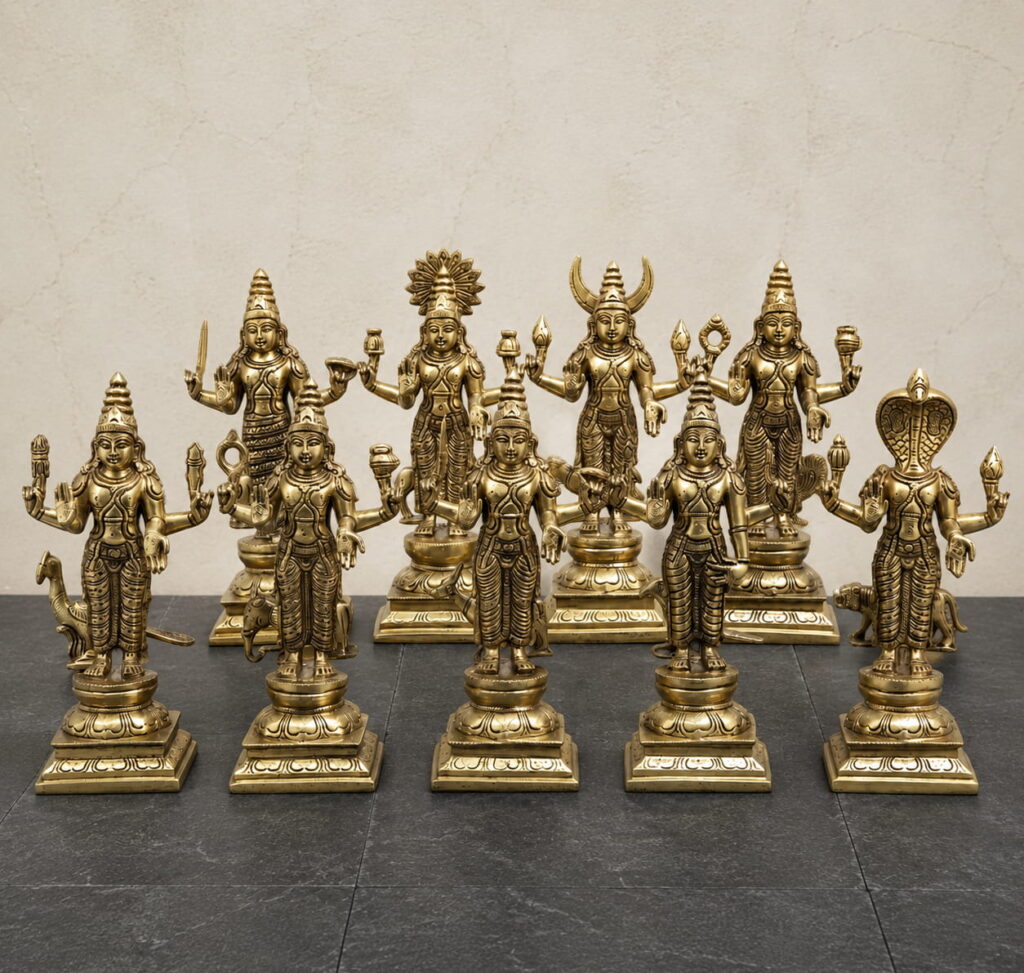
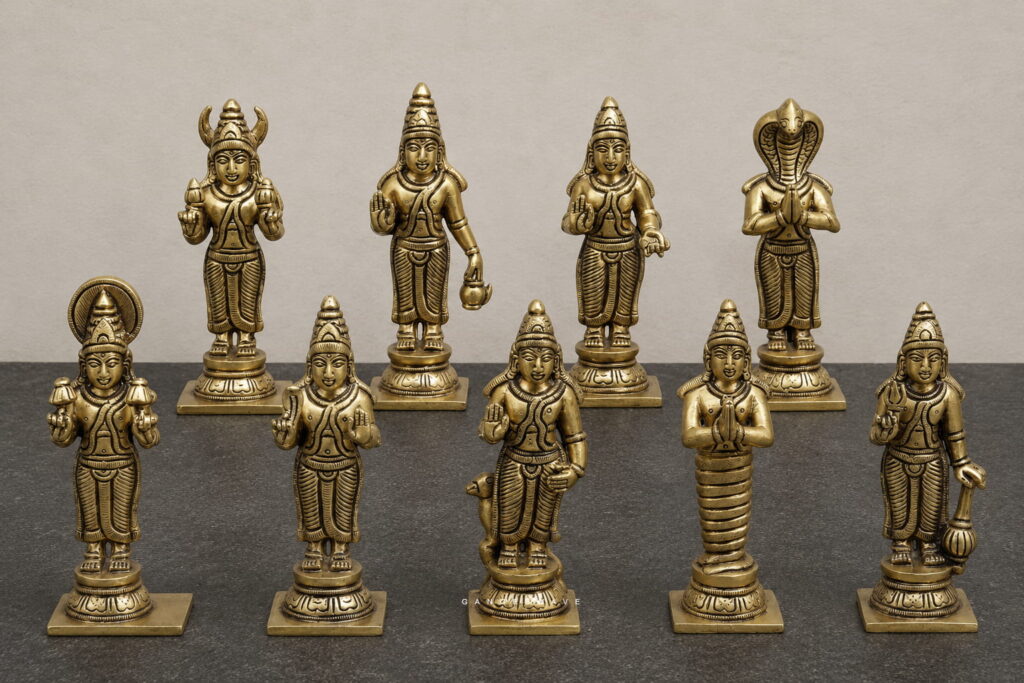
Navagraha idols represent the nine celestial forces of Vedic astrology — Surya (Sun), Chandra (Moon), Mangal (Mars), Budha (Mercury), Guru (Jupiter), Shukra (Venus), Shani (Saturn), Rahu, and Ketu. Brass is the traditional material of choice because of its durability and its long-standing spiritual association with clarity and positive energy in Hindu ritual practice. When selecting a set, prioritize iconographic accuracy (each graha has distinct attributes), a matching finish across all nine idols, and correct directional placement — not just size or price.
If you’ve ever felt like certain areas of life — career, relationships, health, or peace of mind — seem persistently out of sync, you may have come across the idea of “planetary imbalance” in Vedic astrology. Navagraha idols are the traditional way Hindu households and temples address this: by honoring each of the nine grahas individually through worship. This guide walks through what each idol represents, how to choose an authentic and well-proportioned set, and how to place and worship them correctly at home.
Note: The following reflects traditional Vedic astrology (Jyotisha) belief and Hindu ritual practice. It is a spiritual and devotional framework, not a scientific or medical claim.
What Are Navagraha Idols? {#what-are-navagraha-idols}
Navagraha comes from the Sanskrit words nava (“nine”) and graha (“planet,” or more literally, “that which seizes / holds influence”). Navagraha idols are a set of nine small murtis, each representing one of the nine celestial bodies recognized in Vedic astrology, which are believed to influence an individual’s destiny based on their position at the time of birth.
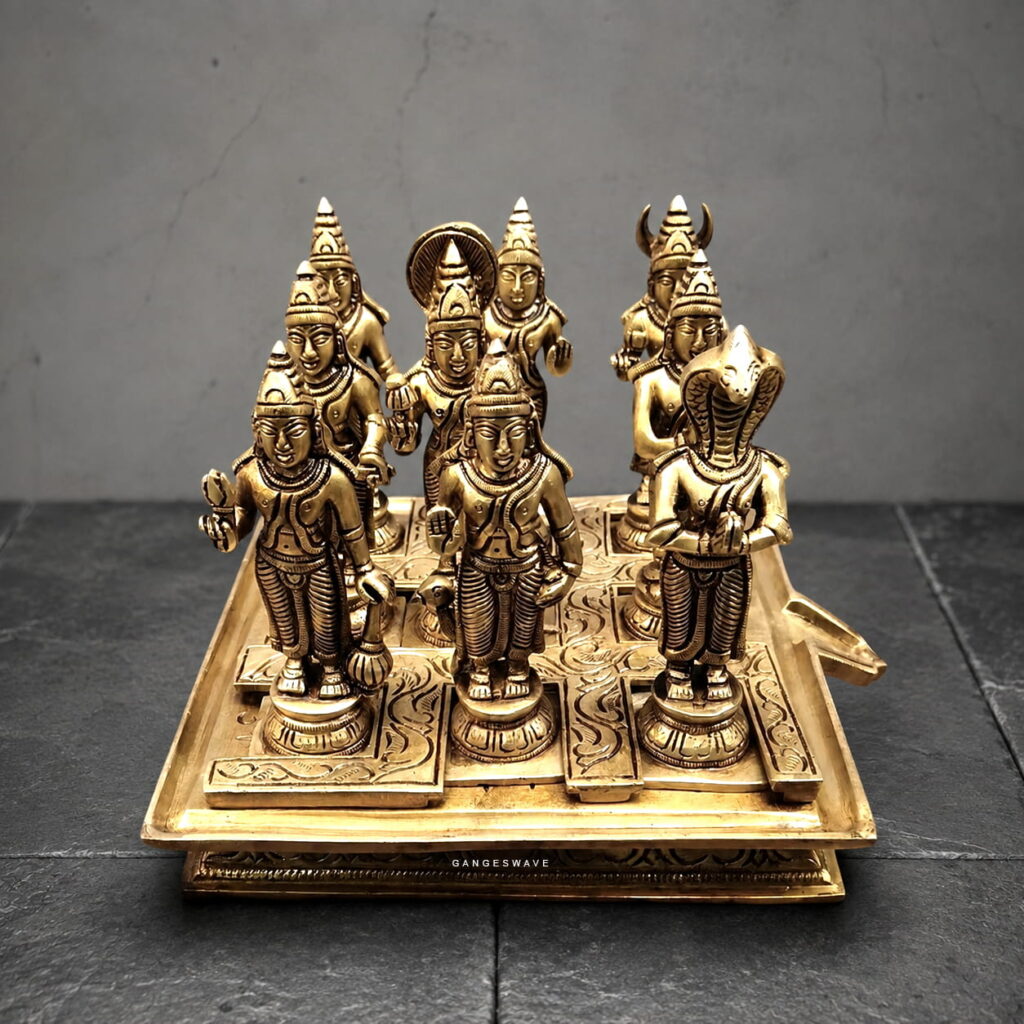
Unlike a single deity idol placed in a home temple for daily devotion, a Navagraha set is typically installed and worshipped as a group of nine, either together on one platform or arranged individually according to prescribed directions. They’re widely used both in home puja rooms and prominently in temples — India’s Navagraha temple circuit in Tamil Nadu, for instance, dedicates nine separate shrines (each with a Shiva sanctum plus a planetary deity shrine) to the nine grahas.
Why Brass Is Traditionally Used for Navagraha Idols {#why-brass}
Brass holds a specific, longstanding place in Hindu ritual metallurgy, and Navagraha idols are almost always cast in it rather than silver, wood, or stone, for a few reasons:
- Durability for daily ritual use: Navagraha idols are typically handled often — moved for cleaning, oiled during abhishekam, and kept near active diyas and incense. Brass withstands this daily contact far better than softer metals.
- Traditional resonance association: Brass has long been used for bells, lamps, and yantras in Hindu ritual, and is believed to hold and transmit spiritual vibration more readily than other common metals — this belief is part of why brass idols are considered auspicious across almost all Hindu deity categories, not just Navagraha sets.
- Consistency across a set of nine: Because all nine idols need to look and feel like a cohesive set, brass’s ability to hold fine, uniform detail through casting makes it easier for artisans to produce nine idols with matching proportions and finish — important since Navagraha idols are judged as a set, not individually.
- Antique finish ages well: A brass Navagraha set develops a deeper patina over years of use, which many households consider a sign of a well-worshipped, “lived-in” sacred object rather than a flaw.
The Nine Grahas and What Each One Represents {#the-nine-grahas}
Each graha idol has a distinct form, vehicle (vahana), and area of life it’s traditionally associated with:
Graha
Represents (in Jyotisha)
Day of the Week
Surya (Sun)
Soul, self-confidence, authority, father
Sunday
Chandra (Moon)
Mind, emotions, intuition, mother
Tuesday
Mangal / Angaraka (Mars)
Courage, energy, siblings, drive
Tuesday
Budha (Mercury)
Intellect, communication, commerce
Wednesday
Guru / Brihaspati (Jupiter)
Wisdom, wealth, spirituality, marriage
Thursday
Shukra (Venus)
Love, beauty, relationships, comfort
Friday
Shani (Saturn)
Discipline, karma, longevity, obstacles
Saturday
Rahu (North Lunar Node)
Ambition, illusion, foreign connections
—
Ketu (South Lunar Node)
Detachment, spirituality, past-life karma
—
How Navagraha Worship Relates to Astrological Balance {#astrological-balance}
In Vedic astrology, an individual’s birth chart (janma kundali) maps the position of each graha at the moment of birth. When a graha is considered weak, afflicted, or poorly placed in someone’s chart — commonly referred to as a dosha (for example, Shani-related “Sade Sati,” or a Rahu-Ketu axis affliction) — it’s believed to manifest as recurring difficulty in the area of life that graha governs.
Navagraha worship is the traditional remedial practice for this: by honoring the specific graha (or the full set of nine, to maintain overall balance), a devotee seeks to pacify its unfavorable influence and strengthen its beneficial one. This is why you’ll often see two different approaches to Navagraha idols in Hindu households:
- A full set of nine, worshipped together for general planetary harmony and household well-being.
- A single, larger idol of one specific graha (most commonly Shani, or Rahu-Ketu), acquired specifically to address a dosha identified by an astrologer.
Both are traditional and valid; the right choice depends on whether you’re seeking general balance or addressing a specific chart reading — which is a decision best made in consultation with a qualified astrologer or family priest rather than guesswork.
How to Choose the Right Navagraha Idol Set {#how-to-choose}
- Check iconographic accuracy first. Each graha has traditional, recognizable attributes — Surya is shown in a chariot drawn by seven horses; Shani is typically seated on or accompanied by a crow; Rahu and Ketu are depicted with serpent tails. A well-made set gets these details right; a mass-produced or inaccurate set often blurs them together.
- Decide between a full set and a single focus-idol. If you don’t have a specific dosha concern, a complete nine-piece set is the traditional default. If you’re addressing a specific planetary affliction, a single, more detailed idol of that graha (often kept larger than it would be within a full set) is more common.
- Match finish and scale across all nine. All nine idols should share the same brass tone (antique, golden butter brass, etc.) and be proportionate to each other — a set where one idol is visibly larger or a different finish than the rest looks incomplete rather than intentional.
- Consider the base/pedestal design. Sets that come with individually labeled or shaped pedestals make correct directional placement significantly easier, especially for someone new to Navagraha worship.
- Verify the count. This sounds obvious, but it’s a common quality-control gap in mass-produced sets — always confirm you’re receiving exactly nine idols, matching the list above, not an incomplete or substituted set.
Correct Placement and Direction {#placement-direction}
Traditional Agama-based temple layout places each graha in a specific direction relative to Surya at the center:
- Surya — center
- Chandra — east
- Budha — south
- Brihaspati (Guru) — west
- Shukra — north
- Mangala — southeast
- Shani — southwest
- Rahu — northwest
- Ketu — northeast
In a home setting, replicating this exact layout isn’t always practical on a small altar. Many households instead arrange the nine idols in a semicircle or row facing the worshipper, with Surya kept at the center as the anchor point — a simplified adaptation that keeps the core symbolic hierarchy (Surya as the central, unifying force) while fitting a typical home puja shelf. If your altar has the space, following the full directional layout is considered more complete and is common in dedicated Navagraha shrines.
How to Worship Navagraha Idols at Home {#how-to-worship}
- Daily or weekly lighting: A simple diya lit in front of the full set is the most common daily practice; some households light a specific lamp on the day associated with a particular graha (e.g., Saturday for Shani).
- Individual mantras: Each graha has a dedicated beej (seed) mantra, traditionally chanted a specific number of times (often in multiples of 108) on its associated day.
- Navagraha Homam: For more significant remedial worship — particularly for dosha correction — a fire ritual (homam) conducted by a priest is the traditional, more elaborate option, usually performed periodically rather than daily.
- Keep the space clean and uncluttered: As with all deity idols, Navagraha sets are kept in a clean, elevated position, away from footwear, laundry, or general storage clutter.
Caring for Brass Navagraha Idols {#care-tips}
- Dust each idol individually with a soft, dry cloth or brush — the smaller size and finer detailing of Navagraha idols means dust and residue collect quickly in the folds of each figure.
- Avoid strong chemical cleaners, which can strip the antique patina and blur fine iconographic detail (like Shani’s crow or Rahu’s serpent tail).
- Handle during abhishekam carefully — if you perform ritual bathing of the idols, dry each one thoroughly afterward, since prolonged moisture can dull brass over time even though it resists corrosion well.
- Store or display all nine together, ideally on a dedicated tray or platform, so the set stays visually and spiritually cohesive rather than idols being scattered across different shelves.
Common Mistakes to Avoid {#common-mistakes}
- Buying a mismatched set — pieces sourced from different sellers or batches rarely share the same finish, scale, or level of detail.
- Ignoring iconographic accuracy in favor of price alone — an inaccurate depiction (missing vahana, wrong number of arms, indistinct Rahu/Ketu forms) undermines the traditional purpose of the idols.
- Skipping the central-Surya principle — even in a simplified home layout, Surya is traditionally kept as the anchoring, central figure rather than placed off to one side.
- Treating the set as pure decor — Navagraha idols are typically installed with some form of consecration or at minimum a simple puja on arrival, rather than placed like a showpiece.
- Choosing size purely for shelf space — very small idols can be difficult to worship with individual attention; if your altar allows it, a moderate size (4–6 inches per idol) is a common, practical middle ground.
Frequently Asked Questions
What are Navagraha idols?
Navagraha idols are a set of nine murtis representing the nine celestial bodies of Vedic astrology — Surya, Chandra, Mangal, Budha, Guru, Shukra, Shani, Rahu, and Ketu — worshipped together to seek planetary balance and remedy astrological doshas.
Why is brass considered the traditional material for Navagraha idols?
Brass is durable enough for frequent ritual handling, holds fine casting detail well (important for a matched set of nine), and carries a long-standing association with positive spiritual vibration in Hindu ritual practice.
Can I worship only one Navagraha idol instead of the full set?
Yes. It’s traditional to acquire and worship a single, larger idol of one specific graha — most commonly Shani or Rahu-Ketu — when addressing a specific dosha identified in a birth chart, rather than the complete nine-piece set.
Where should Navagraha idols be placed at home?
Traditionally, Surya is placed at the center with the other eight grahas arranged around it in specific directions (Chandra east, Shani southwest, and so on). In smaller home altars, a simplified semicircle or row with Surya at the center is a common practical adaptation.
What is the difference between Rahu and Ketu idols?
Rahu and Ketu represent the north and south lunar nodes rather than physical planets, and are typically depicted with serpent-tail forms to visually distinguish them from the other seven grahas.
How often should Navagraha idols be worshipped?
Many households light a lamp daily or weekly in front of the full set, while more elaborate remedial worship — such as a Navagraha Homam — is typically performed periodically with a priest, especially when addressing a specific dosha.
Do all nine Navagraha idols need to be the same size?
For a general worship set, yes — matched scale and finish across all nine idols is considered correct. An exception is when one specific graha idol is deliberately kept larger as a focused remedial piece for a particular dosha.
How do I clean a brass Navagraha idol set without damaging the detail?
Dust each idol individually with a soft, dry cloth, avoid harsh chemical cleaners that can blur fine iconographic detail, and dry idols thoroughly after any ritual bathing (abhishekam).
Looking to bring a well-proportioned, iconographically accurate brass Navagraha set into your home? Explore GangesWave’s handcrafted brass idol collection, made by traditional Indian artisans, at GangesWave.